Ramadan
Overview
Ramadan is the ninth month of the Islamic lunar calendar and the holiest period in the Muslim year. It is observed by fasting from sunrise to sunset, prayer, Quran recitation, self-reflection, and charitable giving, while also cultivating self-control, gratitude, and compassion. Roughly 1.9 billion people across more than 180 countries observe Ramadan, one of the five foundational pillars of Islam. Its origins trace to 610 CE, the year Muslims believe the Prophet Muhammad first received the Quran's revelations during this month in the Cave of Hira outside Mecca.
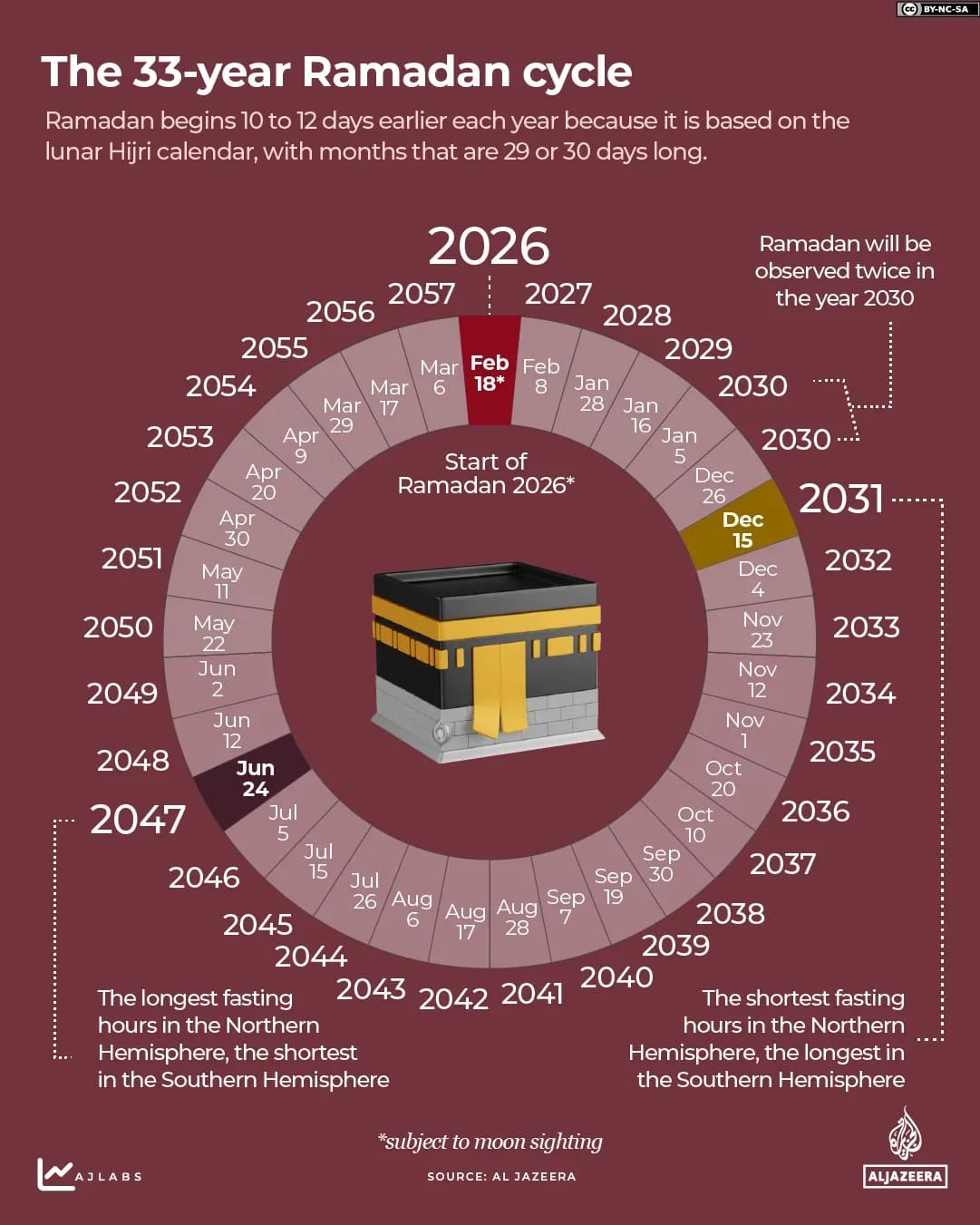
Communities come to life at night as the breaking of the fast—the meal called "iftar— becomes one of the most communal moments of the year (and, in some areas, a major TV event). Ramadan's timing is governed by lunar visibility rather than fixed dates, meaning it officially begins only when a new crescent moon is spotted in the western sky after sunset, which varies by geography. Since 12 moon cycles are roughly 11 days shorter than a solar year, Ramadan occurs roughly 11 days earlier in the Gregorian calendar each year (2030 will see two Ramadans).
Ramadan's spiritual peak comes on Laylat al-Qadr—typically a few days before the end of the lunar month—the commemoration of Muhammad's "night of power," when he received the first Quranic message from the angel Gabriel. The month ends with Eid al-Fitr, a celebration marking the first day of the following month, Shawwal.
1440 Findings
Hours of research by our editors, distilled into minutes of clarity.

Explore Society & Culture
Take a deep dive into the topics shaping our shared norms, values, and institutions. Art, music, and sports. Literature, architecture, and TV. Film, food, and philosophy. If it defines who we are as a society or how we express ourselves as a culture, then we're exploring it here.
Featured Topics
- Barbecue
- Beat Generation
- Bob Dylan
- Broadway
- Bruce Springsteen
- Burning Man
- The Burrito
- Country Music
- Dystopian Literature
- Flannery O’Connor
- Frank Lloyd Wright
- Girl Groups
- Hip-Hop
- James Beard Awards
- Memes
- National Football League
- National Parks
- Netflix
- Opera
- Rock 'N' Roll
- Salvador Dalí
- 'Saturday Night Live'
- Shakespeare
- 'The Star-Spangled Banner'
- Steven Spielberg
- Title IX
- True Crime
- Vacationing
- Walt Whitman