LIGO
Overview
The Laser Interferometer Gravitational-Wave Observatory consists of two detectors in Hanford, Washington, and Livingston, Louisiana, built to observe gravitational waves produced by astronomical phenomena. Like ripples created by objects traveling along water, gravitational waves are ripples produced by objects moving through spacetime. Unlike light, which can be blocked by matter, gravitational waves travel at the speed of light unimpeded, allowing scientists to use LIGO to study otherwise invisible cosmic events, like black holes.
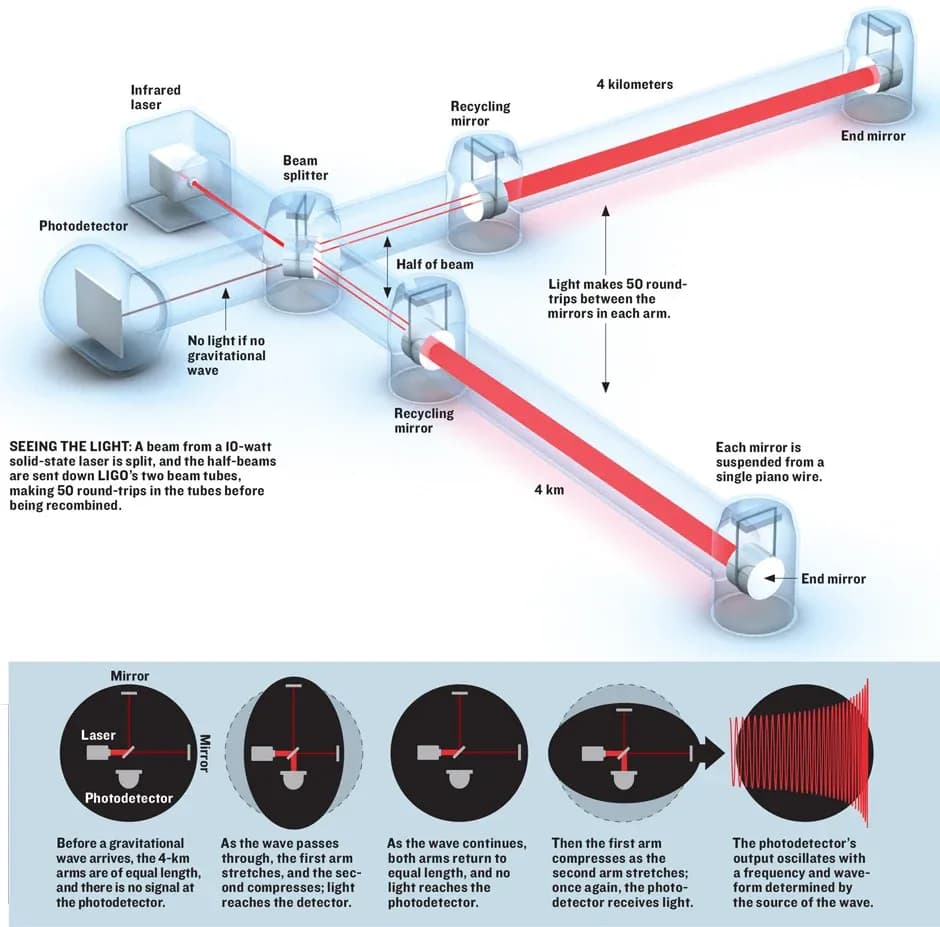
Each detector has two 4-kilometer (2.5-mile) tunnels called arms, which form an "L" shape. During each experimental run, a continuous laser beam is split at the point where the arms connect, with each half sent down an arm. The beams reflect off mirrors—one at the end of the arm and one near where they connect—about 300 times before recombining. A passing gravitational wave will cause the recombined beam to produce a specific pattern, which is compared with patterns produced in simulations to determine the characteristics of the cosmic event that created the waves.
Requiring extensive flat land, minimal seismic activity, and enough space between them to rule out false positives from the local environment, LIGO detectors were built 3,002 kilometers (1,865 miles) apart. Since going online in 2015 after a series of upgrades, LIGO has detected mergers involving black holes and neutron stars and validated predictions made by Albert Einstein and Stephen Hawking.
1440 Findings
Hours of research by our editors, distilled into minutes of clarity.

Explore Science & Technology
Dive into the dynamic world of science and technology, where curiosity has brought about extraordinary understandings of the universe and creativity has led to the breakthroughs and innovations that have transformed our world. Explore a wide range of topics, from the natural and physical sciences to cutting-edge technologies and the people who shaped them, each of which is accompanied by carefully curated resources meant to inform, engage, and inspire those eager to uncover the nature of reality.
Featured Topics
- 3D Printing
- Algae
- Algorithms
- Asteroids
- Atoms
- Auroras
- Batteries
- Big Bang
- Bill Nye
- Biological Cells
- Bioluminescence
- Bioremediation
- Biosphere 2
- Black Holes
- Calculators
- Chaos Theory
- Climatology
- Comets
- Computer Viruses
- Coral Reefs
- Critical Minerals
- Crude Oil
- Cryptography
- Dark Energy
- Dark Matter
- Dark Web
- Data Centers
- David Attenborough
- Deep-Sea Mining
- Deepfakes
- Dinosaurs
- DNA
- Earth
- Earth's Atmosphere
- Earthquakes
- Eclipses
- El Niño-Southern Oscillation
- Electric Grids
- Electric Vehicles
- Electricity
- Environmental Protection Agency
- Extremophiles
- Fireworks
- Fracking
- General Relativity
- Generative AI
- Geothermal Power
- Grace Hopper
- Graphics Processing Unit
- Greenhouse Gases
- Helium
- Hubble Space Telescope
- Hurricanes
- International Space Station
- Internet
- Invasive Species
- James Webb Space Telescope
- Jupiter
- Keystone Species
- Large Hadron Collider
- Large Language Models
- Lasers
- Light
- Lightning
- LIGO
- Marie Curie
- Mars
- Memory
- Microchips
- Microplastics
- Mixed Reality
- Molecular Gastronomy
- Nancy Roman
- NASA
- National Science Foundation
- Neutron Stars
- Nikola Tesla
- Nobel Prize
- Nuclear Power
- Particle Accelerators
- Photosynthesis
- Plate Tectonics
- Pollinators
- Pontifical Academy of Sciences
- Quantum Computing
- Quantum Mechanics
- Radioactivity
- Rosalind Franklin
- Scientific Theory
- Self-Driving Cars
- Smart Cities
- Solar Power
- Sound
- Space Shuttle
- Space Tourism
- Space Trash
- Standard Model
- Stephen Hawking
- Sun
- Tardigrades
- Tesla
- Time
- Tornadoes
- Tsunamis
- Turbulence
- Viking Project
- Volcanoes
- Voyager Mission
- Water
- Wikipedia
- Wind Power